
Rising damp.
Know the signs before choosing treatment.
Damp near the skirting is a reason to investigate. Understand the pattern, rule out other moisture sources and find out whether a remedial damp proof course is appropriate.
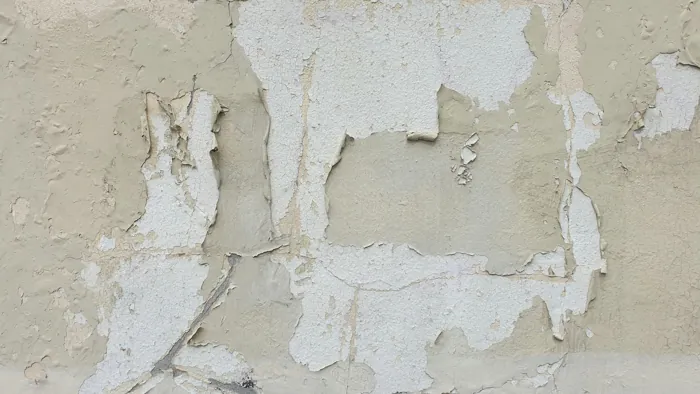
Does this look
familiar?
Start with what you can see. These signs help describe the concern; they do not establish the diagnosis on their own.
How a damp survey worksLow-level staining
Persistent damp or discolouration near the base of a ground-floor wall.
Tide-like marks
A changing boundary between affected and apparently dry plaster.
Salts or crumbling plaster
Deposits, damaged finishes or plaster losing its surface.
Affected skirtings
Flaking paint or deterioration where timber meets a damp wall.
What is rising damp?
Find the cause.
Then choose what it needs.
Rising damp is liquid moisture moving upwards from the ground through porous masonry by capillary action. An effective damp proof course interrupts that route. The condition of the wall, ground levels and connections between floors and walls all matter.
A tide mark or damaged plaster can be a useful clue, but neither proves the source. Different moisture problems can occur together. ThinkDRY considers the building and its history before recommending treatment.
Not sure?
Show us.
Tell us what you are seeing, your postcode and when it started. Photos can help narrow down the concern and decide whether a physical survey is the next step.
Photos cannot confirm hidden defects or replace a physical investigation where one is needed.
Read the building.
Not just the mark.
A moisture reading is one piece of evidence. The materials, distribution, repair history and possible moisture routes need to be considered together.
For physical investigations outside the buyer / seller service, scope and any charge are agreed before booking.
Explore ThinkDRY damp surveys- 01
Trace the moisture pattern
Where does it start, how far does it extend and does it change after rain? Compare the affected wall with adjoining areas.
- 02
Check existing protection
Look at the DPC, outside ground levels, render, floor junctions and possible bridges before deciding a course has failed.
- 03
Interpret the readings
A meter reading is considered alongside construction, salts and visible evidence. It does not establish rising damp on its own.
The right work.
For the actual cause.
When injection may help
Where ground moisture and a suitable wall are established, an injected DPC may form part of the repair. The masonry, mortar, voids and existing protection affect the specification.
Plan plaster and drying separately
Salt-affected or damaged plaster may need attention after the source is controlled. Agree the extent of removal, compatible reinstatement and decoration sequence. Drying depends on the wall and conditions; a fixed deadline would be misleading.
What else
could it be?
Rain entry
Patches linked to rainfall need checks for defects and water ingress.
Explore the guidance 02 / ANOTHER STARTING POINTCondensation
Cold surfaces and indoor moisture may leave mould or surface damp.
Explore the guidance 03 / ANOTHER STARTING POINTBridging or leaks
Raised ground, render across a DPC or a plumbing leak may need a different repair.
Explore the guidanceKnowledge before
treatment.
Show us
Send photographs and describe the symptoms.
Assess
Consider the pattern, history and possible causes.
Investigate
Arrange a physical survey where appropriate.
Explain
Discuss the findings, limits and next step.
Treat
Choose work supported by the diagnosis.
Clear explanations.
A considered next step.
Understand the reason for a proposed repair before deciding what to have done.
Meet ThinkDRYAlan P’s Trustpilot review of 14 May 2026 describes DPC work in a Victorian terrace, an explanation of the work and advice on subsequent decoration.
Alan P · Trustpilot · 14 May 2026. Customer review summary.
Read the original reviews on TrustpilotYour next step.
In the right direction.
Damp proof injection
Understand when an injected course may be appropriate.
Explore damp proof injection 02 / RELATED GUIDANCEDamp proof course
Learn what the barrier does and how it can be bridged.
Explore damp proof course 03 / RELATED GUIDANCEDamp surveys
See how ThinkDRY investigates the cause.
Explore damp surveysBased in Thurlstone, South Yorkshire, ThinkDRY considers enquiries across Sheffield and Yorkshire. Send the full postcode to confirm coverage and arrangements.
Your rising damp
questions.
Eight answers to help you choose a sensible next step.
What are the signs of rising damp?
Low-level moisture, tide-like marks, salts and damaged plaster or skirtings can justify investigation. They are clues, not proof: leaks, bridging and other moisture sources can produce overlapping symptoms.
What causes rising damp?
Ground moisture can move through porous masonry by capillary action where effective protection is absent or bypassed. The wall construction, ground levels and existing DPC need checking together.
How can I tell rising damp from condensation or penetrating damp?
Compare the location and timing. Ground moisture, surface condensation and rain entry have different routes, but appearance alone may not separate them. A building inspection can test the possible explanations.
Does damp at the bottom of a wall always mean rising damp?
No. Check plumbing leaks, floor and wall junctions, outside levels, drainage and bridging as well as condensation and rain penetration.
Does rising damp always require DPC injection?
No. Correcting a bridge or another source may be the appropriate first step. Injection is considered where the diagnosis and masonry support a remedial course.
What happens to damaged plaster after treatment?
The repair plan should identify plaster that is damaged or salt affected and specify suitable reinstatement. Controlling the moisture source and repairing the finish are related but separate tasks.
How long do walls take to dry after rising damp treatment?
It varies with thickness, materials, moisture load, finishes and room conditions. Injection does not instantly dry a wall. Agree how drying and redecoration will be assessed for your property.
Can I send photographs before arranging a survey?
Yes. Start with the free photo assessment, your postcode and a brief history. Photos can help narrow down the next step, but cannot confirm hidden defects or replace a physical investigation when needed.
Let’s find out
what’s causing it.
Damp near the skirting is a reason to investigate. Understand the pattern, rule out other moisture sources and find out whether a remedial damp proof course is appropriate.
Understand the principle.
A drier home.
A clearer next step.
Get a free initial photo assessment. Tell us what you’re seeing and we’ll discuss the right next step.
Based in Thurlstone, serving Sheffield and Yorkshire.
Buying or selling? Physical damp surveys cost £199, deducted from subsequent remedial work carried out by ThinkDRY.
Request your free photo assessment
Tell us about the damp in your property and we’ll help you understand the next step.
Fields marked * are required. Photographs are optional.